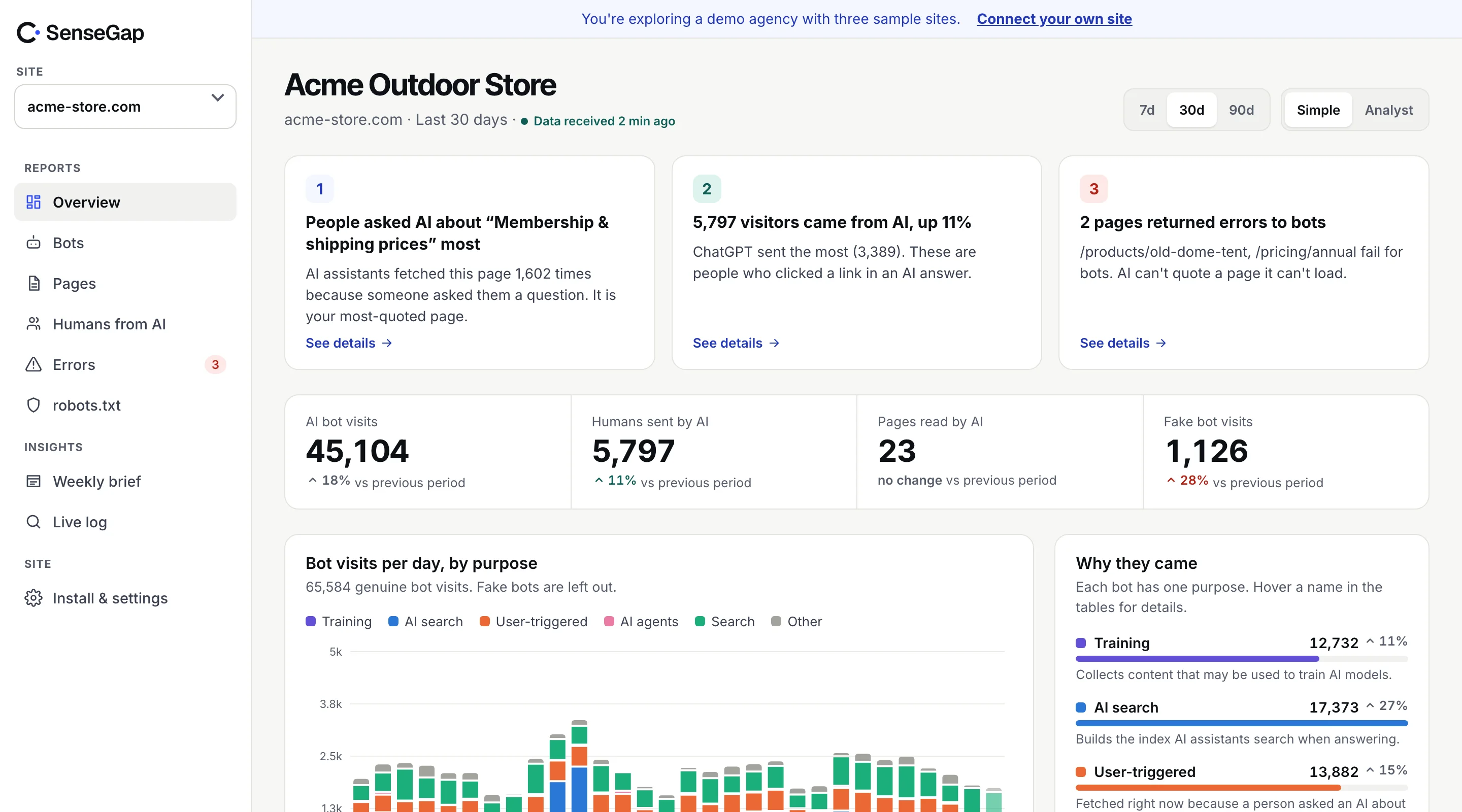
 See it on a real storeBots, pages and people sent by AI on an example store. No sign-up.
IP checker, free, no sign-up.
Is this IP really Googlebot? Or GPTBot, Bingbot, PerplexityBot and 21 more.
How it works, two checks.
The answer comes from the bot's own company. Not from a guess about the user agent.
How we verify bots- 01
Published IP lists
OpenAI, Google, Microsoft, Perplexity, Apple, DuckDuckGo and Common Crawl publish the addresses their bots use. If the address is in the list for that bot, it's real.
- 02
Reverse DNS, both ways
Google, Microsoft, Apple and Amazon also prove bots by name. The address must have a name like
crawl-66-249-66-1.googlebot.com, and that name must point back to the same address. - 03
Everything else is fake
A visit that uses a checkable bot's name but fails both checks didn't come from that company. Bots whose company publishes neither are marked as impossible to check.
The loophole, found November 2026.
Google's own wording lets any Google Cloud VM pass as Googlebot.
Read the researchStep 2 of Google's verification page says a crawler's reverse DNS name should end in googlebot.com, google.com or googleusercontent.com. Every Google Cloud VM has a name under bc.googleusercontent.com that resolves back correctly, so a scanner on a rented VM passes that check.
This checker follows Google's stricter table instead: Googlebot must be googlebot.com, and googleusercontent.com counts only as gae.googleusercontent.com for user-triggered fetchers. When an address is a Google Cloud VM, the result says so.
If a firewall rule, log script or plugin verifies Googlebot by reverse DNS, look at which name endings it accepts. Anything that allows all of googleusercontent.com lets Google Cloud scanners through.
FAQ, checking bot IPs.
Bot IP questions, answered plainly
How do I verify Googlebot by IP address?
Two ways, and this page runs both. First, check the address against the IP list Google publishes for its common crawlers (googlebot.json). Second, look up the address's reverse DNS name, check that it ends in googlebot.com (or google.com for some special crawlers), then look that name up again and make sure it points back to the same address.
Why isn't googleusercontent.com enough?
Every Google Cloud virtual machine gets a reverse DNS name ending in bc.googleusercontent.com, and it resolves back correctly. So anyone renting a VM passes a check that accepts any googleusercontent.com name. Google's own table only allows gae.googleusercontent.com, and only for user-triggered fetchers, not for Googlebot.
Which bots can be checked?
25 of the 55 bots we recognize: OpenAI's GPTBot, OAI-SearchBot and ChatGPT-User, Googlebot and Google's other crawlers, Bingbot, Applebot, PerplexityBot, DuckDuckBot, CCBot and others. Their operators publish IP lists or reverse DNS names.
Why can't ClaudeBot be checked?
Anthropic, Meta, ByteDance and several others publish no IP list and no reverse DNS name for their bots. With nothing to compare against, no tool can prove a visit real or fake. We say so rather than guess.
Is the address I check sent anywhere?
The check runs in your browser. It downloads the published IP lists from SenseGap and asks Cloudflare's public DNS (1.1.1.1) for the address's reverse DNS name. SenseGap's server never sees the address you typed.
Can I link to a result?
Yes. The page address updates with the IP and bot you checked, so you can paste it into a forum thread, a ticket or a firewall rule comment.
How do I check every visit, not one IP?
Drop an access log on the free log checker to check a whole file at once. SenseGap checks every visit to your site as it happens, and shows which pages each AI bot read.