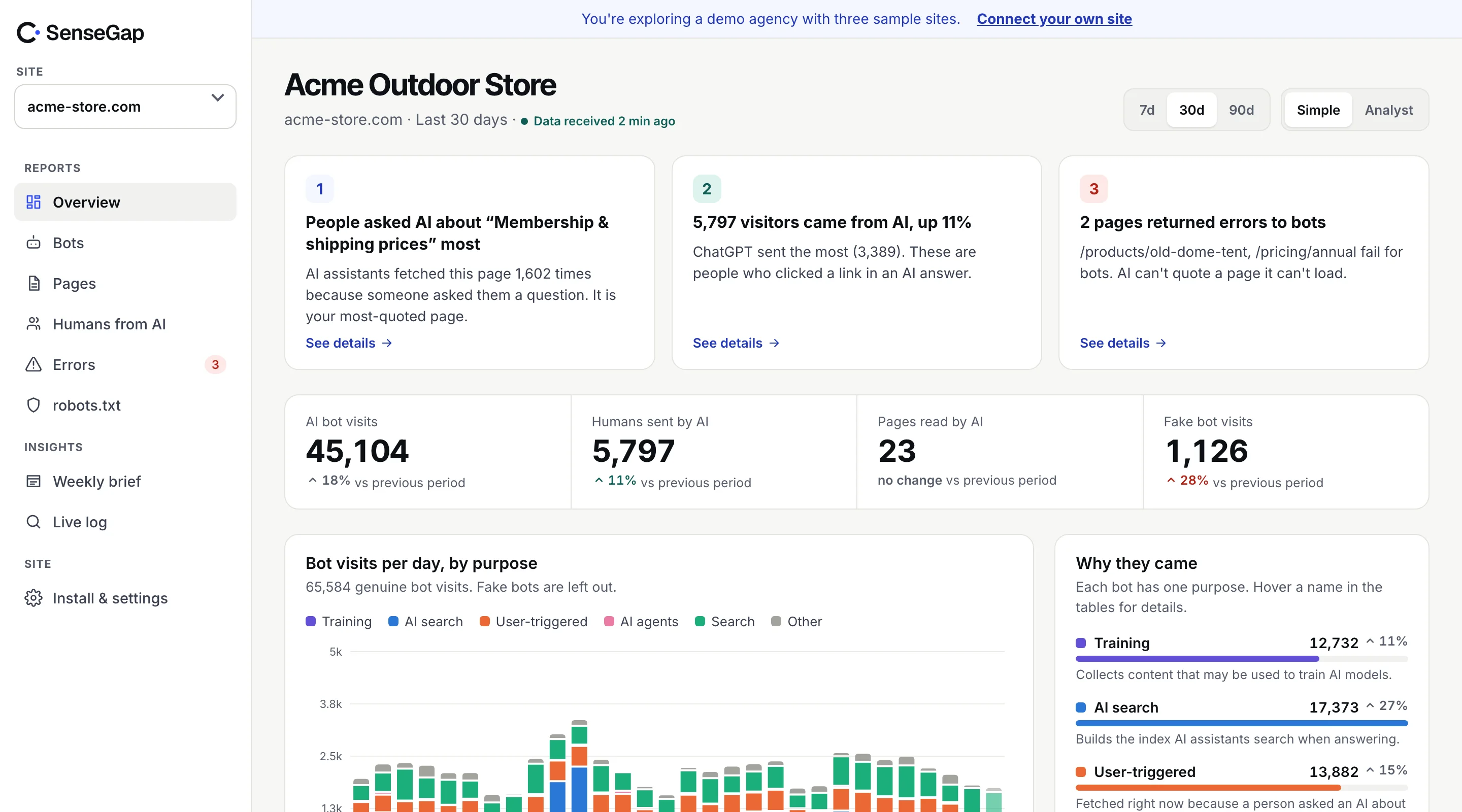
 See it on a real storeBots, pages and people sent by AI on an example store. No sign-up.
Compare, SenseGap and the tools you're weighing.
Pick the AI analytics tool for your question. Some tools count people, some block crawlers, some sample AI answers. SenseGap reads your own traffic.
Comparisons, one page per tool.
SenseGap versus the alternatives. Each page shows where the other tool is better, and links to its sources.
- SenseGap vs Google AnalyticsWho visited my site, where they came from, and did they convert?
- SenseGap vs Cloudflare AI Crawl ControlWhich AI crawlers hit my site, and which should I allow, block or charge?
- SenseGap vs Known AgentsWhich AI agents and bots visit my site, and how do I control them?
- SenseGap vs ProfoundHow does my brand show up in AI answers compared with competitors?
- SenseGap vs Peec AIHow visible is my brand in AI answers, and which sources do they cite?
The landscape, four kinds of tools.
Four kinds of tools, four different questions. Most confusion comes from comparing tools that measure different things.
| Kind of tool | What it measures | Examples |
|---|---|---|
| Web analytics | People who load your pages in a browser, and whether they convert | Google Analytics |
| Edge controls | Which crawlers reach your site, so you can allow, block or charge them | Cloudflare AI Crawl Control |
| AI bot analytics | AI bots and agents visiting your site, and the people AI sends | SenseGap, Known Agents |
| Prompt trackers | How AI answers chosen prompts about your brand and competitors | Profound, Peec AI |
Where SenseGap fits, measured, not sampled.
SenseGap starts from what AI actually did. Every finding comes from real requests to your site, checked and sorted by purpose.
When ChatGPT, Claude or Perplexity reads one of your pages to answer someone, that request reaches your site. SenseGap records it at the edge, checks the bot is real, and sorts it by why it came: answering a person, building a search index, training, or an agent at work.
From there it shows which pages AI relies on, the errors it hits, the people it sends, and the likely topics behind the visits. Plans are $9, $29, $89 or $299 a month, by size. See how it works or pricing.
No tool sees the exact prompts people type. They stay with the AI company. Be wary of any tool that claims otherwise.
Questions, about choosing a tool.
Questions, answered plainly
What kinds of AI analytics tools are there?
Roughly four: web analytics like Google Analytics, which see people; edge controls like Cloudflare AI Crawl Control, which allow or block crawlers; bot analytics like Known Agents and SenseGap, which measure AI visits to your site; and prompt trackers like Profound and Peec AI, which sample AI answers about your brand.
Which tool shows what people ask AI about my business?
No tool can see real prompts; they stay with the AI company. Prompt trackers test questions they choose. SenseGap infers likely topics from the pages assistants read together on your site, and labels them Estimate.
Do I need more than Google Analytics for AI search?
If you care whether AI reads and cites your site, yes. Google Analytics can't see AI crawlers or assistants fetching pages, because they don't run its JavaScript tag.
Is SenseGap cheaper than prompt-tracking tools?
SenseGap costs $9, $29, $89 or $299 a month, by sites and bot visits. Prompt trackers usually price by the number of prompts and models tracked. They measure different things, so compare by the question you need answered.
How do you keep these comparisons fair?
Every claim about another product comes from its own public pages, linked on each comparison and checked on October 27, 2026. Each page also says where the other tool is better. If something is out of date, write to hello@sensegap.com.