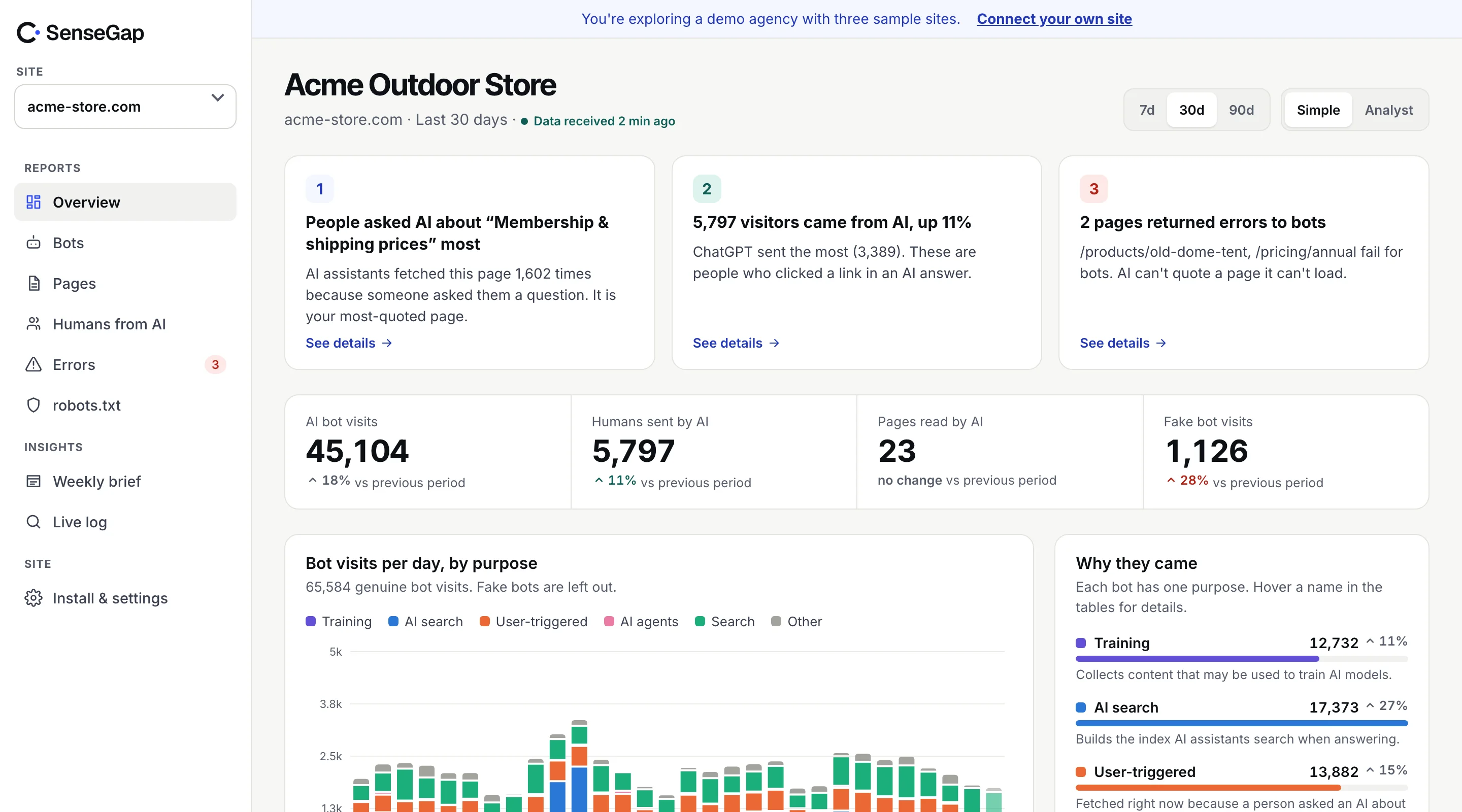
 See it on a real storeBots, pages and people sent by AI on an example store. No sign-up.
Answering a person, run by Anthropic.
What is Claude-User? Anthropic's fetcher for people's AI questions. It can't be verified beyond its name.
Run by Anthropic, which documents it.
Purpose: Answering a person. A visit means a person asked an AI assistant something, and the assistant opened this page to answer.
robots.txt name: Claude-User.
Name only: no published list to check a visit against.
At a glance, the facts in one table.
Claude-User at a glance. Taken from SenseGap's open bot directory, the same data that sorts every visit in the dashboard.
All bots| Claude-User | |
|---|---|
| Operator | Anthropic |
| Purpose | Answering a person |
| User agent contains | Claude-User |
| robots.txt name | Claude-User |
| Verification | Name only |
| Documentation | support.claude.com |
Purpose, what it does and why it came.
What Claude-User does. SenseGap sorts every visit by purpose. Claude-User is in the Answering a person group.
Claude-User is Anthropic's fetcher that opens a page when a person asks Claude something that needs it.
What a visit means
A visit means a person asked an AI assistant something, and the assistant opened this page to answer. It is the one kind of AI visit that implies a real question behind it.
That is why SenseGap pays close attention to this kind of visit. It groups the pages assistants open together to estimate what people likely asked, always labeled as an estimate. Nobody can see the actual questions. How it works.
Detection, the header SenseGap matches.
How SenseGap recognizes Claude-User. By its User-Agent header. A separate check then decides whether the visit is real.
Every request carries a User-Agent header naming the software that sent it. SenseGap counts a request as Claude-User when that header contains Claude-User, in any letter case. The header is plain text, so any script can copy it. Matching the name is where recognition starts, not where trust starts.
/Claude-User/iVerification, how to tell a real visit from a fake.
Claude-User can't be fully verified. SenseGap knows of no published IP ranges or DNS names for it, so the name is all there is.
How we verify botsNot beyond the user agent. SenseGap knows of no published IP ranges or DNS names for Claude-User, so anyone can send its name. SenseGap marks these visits Unverified rather than calling them real.
robots.txt, rules you can copy.
Block or allow Claude-User in robots.txt. Its robots.txt name is Claude-User. Paste a group into the robots.txt at your site's root.
User-agent: Claude-User
Disallow: /User-agent: Claude-User
Allow: /User-agent: Claude-User
Disallow: /private/One rule catches people out. Under the robots.txt standard (RFC 9309), a crawler that finds a group naming it follows only that group and ignores your User-agent: * rules. If you add a Claude-User group, repeat in it anything from the catch-all group you still want applied.
robots.txt is a request, not a lock. To enforce a block, match the User-Agent header at your server or CDN. In nginx:
# nginx, inside a server block
if ($http_user_agent ~* "Claude-User") {
    return 403;
}
SenseGap reads your robots.txt and shows, bot by bot, what you allow and which bots fetched pages you disallowed. See what you get.
Trade-off, what blocking changes.
Should you block Claude-User? It depends on what you want from Anthropic. Here is what each choice means.
If you allow it
The assistant can read your page while it answers, quote it and link to it.
If you block it
The assistant cannot open your page when someone asks, so it answers from other sources, or from what it already knows about you. Anthropic says blocking Claude-User stops Claude from retrieving your content when a person asks for it.
Anthropic, every bot it runs.
More bots from Anthropic. Anthropic runs 4 bots in the directory, each with its own job.
Answering a person, other bots with the same job.
Other bots that answer people. Same purpose, different companies.
Browse the directoryFAQ, Claude-User in short answers.
Claude-User, answered plainly
What is Claude-User?
Claude-User is Anthropic's fetcher that opens a page when a person asks Claude something that needs it.
Who runs Claude-User?
Anthropic. Anthropic documents it at https://support.claude.com/en/articles/8896518.
What does a visit from Claude-User mean?
A visit means a person asked an AI assistant something, and the assistant opened this page to answer. It is the one kind of AI visit that implies a real question behind it.
What user agent does Claude-User use?
Its User-Agent header contains "Claude-User". SenseGap matches it regardless of letter case.
How do I block Claude-User?
Add "User-agent: Claude-User" followed by "Disallow: /" to your robots.txt. robots.txt is a request, not a lock; to enforce it, block the user agent at your server or CDN.
Can I verify that a visit is really Claude-User?
Not beyond the user agent. SenseGap knows of no published IP ranges or DNS names for Claude-User, so anyone can send its name. SenseGap marks these visits Unverified rather than calling them real.
Does Anthropic publish IP ranges for Claude-User?
No. SenseGap knows of no published list of addresses for Claude-User.
What happens if I block Claude-User?
The assistant cannot open your page when someone asks, so it answers from other sources, or from what it already knows about you. Anthropic says blocking Claude-User stops Claude from retrieving your content when a person asks for it.